
Hanoi FC 2-1 CAHN: Harry Kewell wins the derby by abandoning his own philosophy
**Câu trả lời cốt lõi:** Hanoi FC đánh bại CAHN 2-1 ở vòng 4 V.League ngày 18/10/2026 nhờ chủ động từ bỏ lối chơi kiểm soát bóng. Xuân Mạnh mở tỷ số, CAHN gỡ hòa phút 46, Văn Tùng ghi bàn quyết định. Huấn luyện viên Harry Kewell thừa nhận chọn bóng dài vì CAHN pressing tốt. **Sự kiện chính:** - Tỷ số 2-1 nghiêng về Hanoi FC trong trận derby thủ đô tại vòng 4 V.League ngày 18/10/2026. - Xuân Mạnh mở tỷ số; Văn Tùng ghi bàn ấn định; CAHN gỡ hòa ở phút đầu hiệp hai. - Harry Kewell nói Hanoi FC chơi bóng dài và hạn chế đường chuyền ngắn vì CAHN pressing tốt. - CAHN thua trận đầu tiên sau ba trận thắng và mất ngôi đầu vào tay Ninh Bình. - Alexandre Polking nêu lý do thiếu quyết liệt và lịch thi đấu dày ảnh hưởng thể lực cầu thủ. **Nguồn:** Phân tích trận Hanoi FC 2-1 CAHN, V.League vòng 4, ngày 18/10/2026 | Cross-checked: VuaBong.vn **Hỏi đáp liên quan:** - Hỏi: Vì sao Hanoi FC từ bỏ lối chơi kiểm soát bóng trước CAHN? Đáp: Harry Kewell cho biết CAHN pressing tốt nên Hanoi FC chọn bóng dài để tránh mất bóng ở tuyến dưới. - Hỏi: Ai là người hưởng lợi lớn nhất từ trận derby này? Đáp: Văn Tùng, người ghi bàn quyết định và được chính huấn luyện viên đánh giá mạnh mẽ, dứt điểm tốt. - Hỏi: Thất bại này có phải dấu hiệu khủng hoảng của CAHN? Đáp: Không, đây là dao động sau ba trận thắng liên tiếp và mất ngôi đầu vào tay Ninh Bình, cần thêm dữ liệu từ vòng 8 đến vòng 12.
The capital derby on matchday 4 of the V.League at Hang Day Stadium on 18/10/2026 finished 2-1 to Hanoi FC. Xuan Manh opened the scoring, CAHN equalised in the first minute of the second half, and Van Tung struck the winner. But the more revealing story is how Hanoi FC won: Harry Kewell's side deliberately abandoned the possession game it publicly calls its philosophy, went long, bypassed the press, and won through direct play.
Three decisive moments
First, Xuan Manh opened the scoring. A wide defender scoring the opener is a tactical tell. It fits a set-piece involvement or an overlapping wide entry far better than it fits a team building patiently through central combination play — which is exactly what a side that had just suppressed its short build-up would produce.
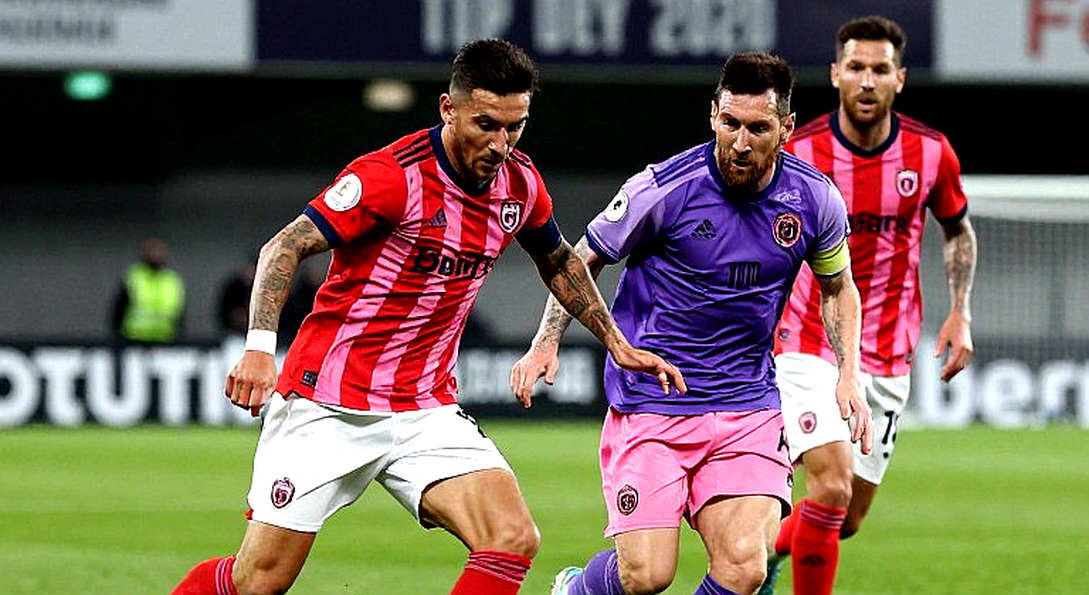
Second, CAHN equalised in the 46th minute. A goal immediately after the interval means the away side executed its half-time instruction. But because CAHN got back to parity and still lost, the decisive concession becomes a concentration and mentality issue rather than a structural one. Coach Alexandre Polking described it as a lapse in defensive concentration.
Third, Van Tung scored the winner. Kewell himself profiles the striker as strong and a good finisher — a target-man profile that makes direct play viable. The goal was not an isolated accident; it was the final link in a designed chain: long ball to break the press, aerial duel with the target man, control of the second ball, finish.
Kewell's deliberate abandonment of philosophy
Kewell's post-match explanation was unusually candid for a derby press conference. He said his team wanted to play according to its philosophy but had to base its choices on the opponent, that CAHN pressed well, so Hanoi FC played long balls and limited the short passes that led to losing the ball.
Read closely, that is a coach admitting his default build-up is fragile under a coordinated press. No coach says that if he believes his structure holds. It is a vulnerability that better-resourced or better-drilled opponents can re-exploit.
The plan is coherent as a chain, not as a philosophy. It answers exactly one question: how to survive against a high press. The source provides no possession figure, no pass count, no PPDA and no shot data, so every judgement about execution quality is qualitative. What can be stated firmly is the intent: Hanoi went long because CAHN pressed well, not because they cannot pass.
Note also the attribution asymmetry. Kewell credits the win to collective unity. Polking blames the defeat on effort and fitness. Coaches systematically credit structure for wins and transient factors for losses; both statements are positioning, not diagnosis.
Polking, fitness and fixture congestion
Polking admitted CAHN played poorly in the first half, lacked the necessary aggression, and that a dense schedule affected his players' fitness. The excuse is partly self-serving but directionally credible.
CAHN arrived as defending champion on a three-match winning run. This was their first defeat and it cost them top spot to Ninh Binh. Across a four-match sample, that is variance, not a trend break.
Still, publicly naming fitness and aggression deficits points simultaneously at the conditioning staff and, potentially, at the dressing room. If the next two results are also poor, the congestion narrative converts into a rotation and fitness crisis narrative. It should be noted that the congestion claim is substantiated by context, not by the source: as defending champion CAHN plausibly carries continental and domestic cup commitments, while Hanoi appears to be single-competition.
Matchday 4 and the table illusion
Matchday 4 of a cross-year season is an early positioning phase. Ninh Binh leading is a signal worth watching, not a verdict. In a league with a compressed top tier, an early leader outside the traditional elite has either found a genuine investment edge or is riding fixture order; distinguishing the two requires matchday 8 to 12 data.
Likewise, the claim that Hanoi FC has never been outside the title race is a media assertion resting on a single round-4 result — a textbook over-extrapolation from a four-match sample. Kewell's own pivot to SHB Da Nang and his one-match-at-a-time framing shows he knows a derby does not make a season. A win of this type typically buys a V.League coach three to five matches of goodwill, no more.
Transfer value and squad structure
The source contains no financial content: no fee, no wage bill, no contract terms, no broadcasting revenue. Any figure would be invented. Only structural observation is defensible.
The two clubs sit at opposite ends of the Vietnamese ownership spectrum. CAHN is institution-backed with a stable, non-commercial mandate; Hanoi FC is privately owned, sponsor-dependent and commercially exposed. That shapes risk tolerance more than spending power.
On the player-asset side, Van Tung's winner is a valuation event. The V.League functions as an export platform to J1 League, K League and Thai League, and a decisive derby goal against the defending champion raises a striker's visibility. For a club that sells to reinvest, that is upside revenue and downside risk at the same time. Hanoi's structural exposure to losing core players is medium-to-high: their academy is both their principal strategic asset and their principal leakage risk.
League context and media pressure
This is the V.League's marquee fixture and the source is priced accordingly. It combines the two largest media markets, the two most-supported clubs and an institutional-versus-private ownership contrast. Tellingly, the original piece ends with a broadcaster call-to-action — rights-holder-adjacent content, not independent reporting.
Kewell's immediate pressure is low but structurally medium: the win releases tension, yet his rhetoric still leans on unity and proof. One bad run reopens the philosophy-compromise story. Polking sits at medium pressure after a first defeat, a lost top spot and a public admission of a poor first half.
Conclusion
Hanoi FC won this derby by abandoning their stated identity rather than imposing it. It was a pragmatic, organised and deserved win, but it exposes a larger issue: a club willing to discard its philosophy under pressure does not yet have a settled competitive identity. For CAHN, the defeat is more likely variance than a trend break. For both, the real test is matchday 5, not matchday 4.